
Short answer
31 terms from Abrasive to Volume expansion, each explained briefly and clearly. Terms with a dotted line are explained throughout the Reference guide when you hover over them.
As of November 2026
01
Find a term.
Search
02
From abrasive to volume expansion.
31 of 31 terms
- Abrasive
- A process that removes material from the surface during cleaning, such as sandblasting. Dry ice blasting is non-abrasive.
- Extraction
- Industrial vacuums collect the blasted-off substances that are captured inside the enclosure.
- bitumen
- Tough, tar-like mass in seals and coatings. Dry ice can even remove layers 3 cm thick.
- CO₂ (carbon dioxide)
- Colourless, tasteless and odourless gas that occurs naturally in the atmosphere. In solid form, it is dry ice.
- Cold Jet
- Global market leader for dry ice blasting equipment. Egger PowAir exclusively uses machines from Cold Jet.
- Decontamination
- The removal of contaminants from surfaces, for example in food and medical device manufacturing.
- Compressed air
- Carries the dry ice pellets through the nozzle onto the surface at high velocity.
- Nozzle
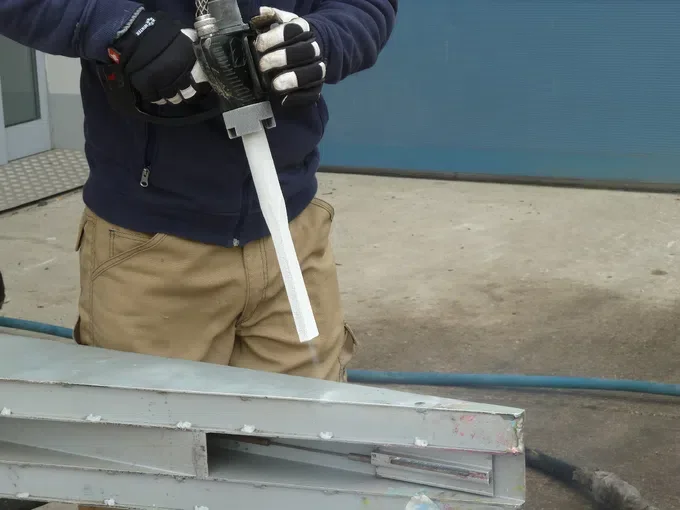
- Specialised nozzle that shapes the blast stream and directs it onto the area to be cleaned.
- Enclosure
- Shielding around the working area in which the blasted-off substances are captured.
- Glass bead blasting
- Blasting process using glass beads as blasting media. The beads accumulate as secondary waste.
- Hot runner system
- Heated part of an injection moulding tool. Can be cleaned with dry ice without dismantling.
- High-pressure cleaning
- Cleaning with water under high pressure. The contaminated water must be disposed of.
- Thermal shock
- Sudden cooling of the layer of dirt caused by pellets at minus 78 degrees. The layer becomes brittle.
- Cold compressed air (CCA)
- Second dry process from Egger PowAir that cleans exclusively with cold compressed air.
- Compressor
- Generates the compressed air for the blasting machine. Requirement per machine: [Wert].
- Laser cleaning
- Process in which laser light removes layers from the surface without blasting media.
- Microcracks
- Fine cracks that the thermal shock creates in the layer of dirt. The subsequent ice expands as it sublimes inside them.
- Online cleaning
- Cleaning during ongoing operation, without dismantling the plant.
- Pellet
- Dry ice in 3 mm cylindrical pellets. Mass and density determine the cleaning performance.
- PSA
- Personal protective equipment. At Egger PowAir, for example, a full suit with fresh-air-purged full-face visor mask and hearing protection. Work is always carried out in pairs: one person cleans, one acts as safety backup.
- Sandblasting
- Blasting process using sand. Large quantities of dust and contaminated sand are generated.
- Secondary waste
- Spent blasting media that must be disposed of in addition to the removed substance. With dry ice, none is produced.
- Soda blasting
- Blasting process using sodium bicarbonate as blasting media. The residues must be removed.
- Blasting pressure
- Pressure with which the pellets strike the surface, adjustable depending on the task: [Wert].
- Blasting unit
- Machine that meters dry ice and delivers it to the nozzle using compressed air.
- Blasting media
- The medium used for blasting: sand, soda, glass beads, water or dry ice.
- Sublimation
- Direct transition from the solid to the gaseous state. Dry ice never turns liquid.
- Dry ice
- Solid aggregate state of carbon dioxide at minus 78.48 °C. Dry, because no liquid forms upon evaporation.
- Dry ice snow
- Finest form of dry ice for sensitive surfaces and precision cleaning.
- Encapsulation
- Sealing in fire odour during fire damage restoration. Required significantly less often after dry ice blasting.
- volume expansion
- Dry ice expands to 760 times its volume upon subliming, thereby lifting off the dirt.
A
E
B
C
D
C
N
E
G
H
T
C
L
M
O
P
S
B
S
D
E
V