
Food productionHow do you clean Food processing plants dry?
Short answer
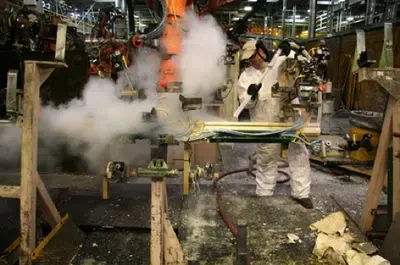
With dry ice or cold dry compressed air, without water, chemicals, or cleaning agents. A deep clean once or twice a year during shutdowns plus routine cleaning has proven effective. Cleaning can also be carried out in three-shift operation, with cordoning off, continuous oxygen measurement, and a risk assessment prior to starting work.
As of November 2026
Why without water.
In food processing facilities, water and chemicals are often the real problem when cleaning. Dry ice cleans dry and without cleaning agents; it sublimates without leaving any residue. Conveyor belts, ovens, portioners, baking lines, and packaging machines become clean without moisture entering the system.
Air has a very small head. It reaches into every crevice and every corner where hands, cleaning cloths, brushes, or vacuum cleaner attachments cannot reach. That is why non-contact cleaning is superior to manual cleaning in terms of cleanliness level, not just in terms of time.
The right schedule.
- Deep cleaningOnce or twice a year as part of shutdowns and maintenance work.
- Routine cleaningAt shorter intervals, roughly fortnightly. Regardless of frequency, the price remains the same all-inclusive hourly rate.
- Trial cleaningIn advance on selected items. Afterwards, the required effort for your own plant can be assessed.
Safety in operation.
This is how a cleaning trial at a confectionery manufacturer was coordinated with their safety officer. The points apply accordingly to any food processing facility.
| Item | Implementation |
|---|---|
| Cordoning off | Generous cordoning off, enclosure of the area |
| Oxygen | Regular residual oxygen measurement by the Egger team, trained in handling gas detection devices |
| Risk assessment | Available before work commences, for internal and external personnel: noise, climate, temperatures, mechanical hazards, electricity, biological hazards |
| Permit | Plant CO₂ permit, adapted for compressed air cleaning |
| Noise | Around 85 dB at 7 bar, around 95 dB at 10 bar |
| Particle dispersion | Approximately 3 to 5 metres, depending on area and material |
| After work | CO₂ measurement, because the gas can accumulate in depressions |
Limitations of the process.
Where the process reaches its limits is stated here before you make an enquiry. Described by the technical department at Egger PowAir.
- Soft surfaces such as plaster, insulation materials, brick, and timber can only be blasted without damage under certain conditions. Hard surfaces such as plastics, aluminium, cast metal, and rubber are suitable.
- Pellets up to 3 mm in size, when applied correctly. This requires trained personnel who clean industrial plants daily.
- The disposal of blasted food residues is borne by the operator.
Frequently asked questions.
How often should a production plant be cleaned?
A deep clean once or twice a year during shutdowns, supplemented by routine cleaning at shorter intervals, has proven effective. The hourly rate remains the same.
How fast is this compared to manual cleaning?
The time saved is important, but not the most important factor. What is crucial is the degree of cleanliness: air reaches crevices and corners that cannot be accessed manually.
Do chains and bearings get damaged?
Cold dry compressed air, dry ice snow, or dry ice pellets up to 3 mm are suitable for all hard surfaces when applied correctly. This requires trained personnel with the right equipment.
Can cleaning be carried out during shift work?
Yes, in three-shift operation and with up to three teams simultaneously. Set-up times for the enclosure are factored in.